Raising a Livestock Guardian Dog Puppy: Essential Supplies and Training Tips
Preparing for a livestock guardian dog (LGD) puppy shares many similarities with preparing for any new puppy, but there are a few important considerations specific to LGDs. At Waterloo Mountain Farm, our philosophy is to begin raising puppies inside the home, where they can learn basic manners, develop a strong bond with their people, and become comfortable with everyday handling and routines.
Some approaches suggest that livestock guardian puppies should live exclusively with livestock from the start in order to “bond” with the animals. While early exposure to stock is certainly important, we believe the bond between dog and shepherd is the foundation of a reliable guardian. A puppy is still a baby, and expecting very young dogs to perform their future job immediately is unfair to the dog, and a recipe for poor habits.
Early experiences such as basic house training, crate comfort, grooming, and calm interaction with people help create a confident and adaptable dog. As the puppy matures, these foundations make it easier to introduce livestock and develop the steady, thoughtful guardian instincts that livestock guardian dogs are known for.
This article isn’t meant to be a comprehensive guide to raising a puppy. There are already plenty of excellent resources that cover the basics of puppy care and training. Instead, this guide focuses on the supplies, tools, and considerations that are particularly relevant when raising a livestock guardian dog, especially on a small farm or homestead.
Good Fences Make Good Guardian Dogs
Good fencing is one of the most important investments you can make when raising a livestock guardian dog. Even dogs with excellent genetics and strong guarding instincts may wander if property boundaries aren’t clear, and once they leave the pasture they face a variety of dangers.
At best, you will have annoyed neighbors and the inconvenience of having to track down and fetch your dog. At worst, your stock are left unprotected, and your dog faces death from busy roads and inattentive drivers, conflicts with predators, hostile or well-meaning neighbors, poisoning, traps, and exposure and starvation.
Research has shown just how serious this risk can be. A long-term study of livestock guardian dogs found that only about 52 percent lived to be six years old, and 57 percent of the dogs that died were killed after leaving the property (Lorenz, Coppinger, & Sutherland, 1986).
The chart below shows the survival rate of livestock guardian dogs over a six-year period and the most common causes of loss reported in the study.
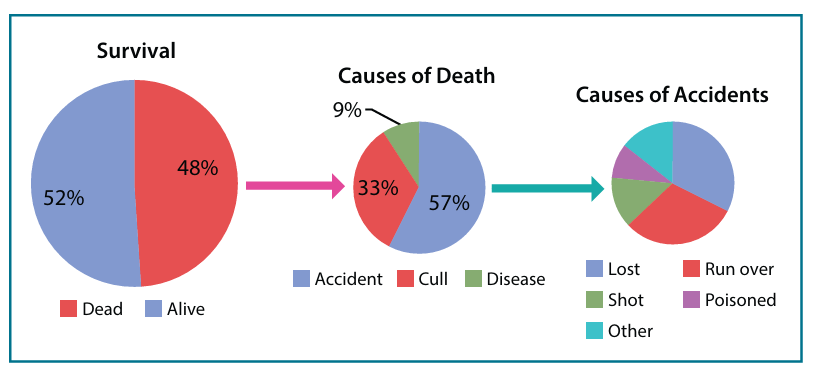
Six year survival of LGDs and causes of losses. Most accidents would not have occurred if the LGD had not left the grower’s property (Lorenz et al. 1986). Graphic Source: Redden, R., & Tomecek, J. (2016). Livestock guardian dogs. Texas A&M AgriLife Extension Service / Texas A&M Natural Resources Institute. https://texnat.tamu.edu/files/2010/08/Livestock-Guardian-Dogs-2016.pdf
Because of this, livestock guardian dogs should always be raised with clear physical boundaries. Reliable fencing not only protects your dog but also helps them learn the limits of the territory they are responsible for guarding.
Many people have a romantic image of how shepherding “used to be,” where dogs simply stayed with their flock on open range. But the same study showed that dogs working on open rangelands died more frequently than those working on farms or fenced ranches, and deaths were especially pronounced among dogs younger than 30 months. While some dogs will happily stay in their area fencing or no, and good genetics play a part in ensuring a dog feels compelled to stay close to home and its stock, given the risks involved, I would not recommend going without a fence.
Virtual Fences
In general, I do not recommend virtual fences as the sole containment method. Because the system is virtual, it can be hard for the dog to develop a concrete understanding of where the actual boundary is.
Where a virtual fence system can work is when accompanied by a physical fence that the dog can otherwise easily get past, such as wire strand fencing they could pass through, or shorter fences the dog could jump or climb over. The physical fence helps them understand the boundary, and makes it so they cannot easily get over the fence while also ignoring the correction. It can also function as a sort of insurance for your outer perimeter in addition to hard fence if your dog ever gets out.
Our recommendation
Many owners can get by with 4 or 5 foot woven wire fences. Adding hot wire at the top (to deter climbing) and bottom (to deter digging) will improve reliability. In an ideal world with unlimited money, 6 foot no-climb fence, especially accompanied by hot wire, will contain your dog, stock, and will keep all but the most determined or wily predators from making an attempt on your stock. However, this is cost prohibitive for most people and often negates the need for an LGD at all. With good genetics, good training and a great bond with your dog, the above should suffice.
Training and Recommended Reading
One thing LGD owners quickly discover is that there are many different opinions about how these dogs should be raised. Peruse livestock guardian groups online and you’ll hear all kinds of conflicting advice about what you should or shouldn’t do with your dog, confidently shared by people whose dogs, experience, and circumstances may be very different from your own. It can be hard to cut through all the noise and figure out what will be right for you.
For those interested in a structured training program, Farei Kennels offers an approach to raising livestock guardian dogs that emphasizes the role of the shepherd and the importance of the human–dog partnership. Their philosophy aligns well with the idea that guardian dogs work best when they have a strong relationship with the person guiding them. Farei Kennels has a monthly membership price, but you only need a few months to get through their program, and you can cancel your membership when you’re done, or keep it if you find the community beneficial. They also have an associated Facebook group, The Truth About Livestock Guardian Dogs. Word of warning, the admins there like to go on occasional rants, and have a less than generous view of the CMDR, but when it comes to training, they’re still a solid source.
Another book worth reading is The Way of the Pack: Understanding and Living with Livestock Guardian Dogs by Brenda M. Negri. While it does include some practical advice about raising an LGD, it’s not really a step-by-step training manual. Instead, the book spends more time exploring the philosophy of working with guardian dogs in a shepherd-centered way, how guardian dogs think and how the relationship between dog and shepherd shapes their behavior.. Negri challenges a few common LGD myths, especially the idea that Old World shepherds raised semi-feral dogs that bonded only to livestock, and the relatively modern belief that regular human interaction somehow “ruins” a livestock guardian dog.
Negri clearly has a lot of experience working with dogs in large livestock operations. She also has a lot of opinions, and the tone can be a bit blunt and judgmental at times. She’s openly skeptical of “people on the internet” (which, to be fair, is often justified) and she has a dim view of modern training “gadgets”. At times she also makes some sweeping assumptions about readers that feel a bit dismissive of small homesteaders or anyone not running larger operations.
That said, I don’t think you need to agree with everything in the book to benefit from it. Take what resonates and leave the rest.
At the end of the day, what really matters isn’t specific training programs, but building trust, maintaining clear boundaries, and consistently reinforcing the behaviors you want to see. With time, patience, and thoughtful training, these dogs grow into the calm, dependable guardians they were meant to be.
Containment and Sleeping
Crate with Divider
Even though livestock guardian dogs will eventually spend most of their time outdoors with livestock, crate training is still an important foundation during puppyhood. A crate with a divider allows you to adjust the space as the puppy grows, preventing them from having enough room to sleep on one side and use the other as a bathroom. This helps reinforce a puppy’s natural instinct to keep their sleeping area clean and greatly speeds up the house-training process.
Crate training also helps puppies learn to settle calmly, travel safely, and tolerate temporary confinement when necessary. Throughout their lives, your dog may need to be crated at the veterinarian, during travel, during recovery from an injury, or while staying inside the house during severe weather. Teaching a puppy to feel comfortable and relaxed in a crate early on ensures that these situations are low-stress and manageable later in life, even for a dog whose primary job will be outdoors guarding livestock
Your crate can also be used for safe extended exposure to livestock. Place your puppy and crate in the animal area, ideally with something distracting and tasty to build positive associations between your pup and your stock. Allow your stock to investigate and grow used to this new addition to the farm. The animals can come and go at their leisure, and your pup in turn can smell and see the stock without the possibility of them getting into mischief or unwittingly harming your stock.
Padding?
We don’t recommend anything beyond perhaps an old blanket or towel to pad out a crate. Companies sell crate pads made to fit their crates that seem like a kind idea for your puppy, but we’ve found these to be unnecessary. Puppies will often get overheated on them, and might shred them if they get bored. Additionally, if your puppy has an accident in their crate it’s a pain to clean them up. A blanket gives them some padding with the option to move it out of the way in favor of the cool surface of the crate floor, are easy to throw in the wash, and your feelings won’t get too hurt if they end up destroying it.
Crate Training Tools
Anyone who has ever crate trained a puppy will tell you that it is not for the faint of heart. Most puppies will resist confinement, and it takes a lot of positive reinforcement to get them to enjoy being in their crate. In the olden days, you might have to throw small treats inside, or put a lick toy inside that the puppies would almost always try to take with them outside of the crate. But now there is the Diggs Groove Crate Training Tool.
With this device, you can freeze peanut butter or the spreadable treat of your choice into the tool, and when you need to put the puppy in the crate, you simply slide it between the bars of your crate and lock it into place. This forces your puppy to stay in the crate in order to receive their delicious treat, and makes it very easy to work up to your puppy from being comfortable in the crate with the door open to enjoying the crate even with the door closed. Sometimes they’ll get so tuckered out from licking they’ll fall asleep in the crate, and it’s pretty smooth sailing from there.
With our second LGD OUM Babka, she would actively look forward to crate time, and would barrel straight into her crate in eager anticipation of her licking time.
Housetraining
Dog Doorbell
While livestock guardian dogs will eventually spend most of their time outdoors, teaching them how to communicate they need to go outside can still be useful when your dog is inside the house during puppyhood or later in life during travel, vet visits, or bad weather. This is especially so for male dogs, who may try to mark inside if you have a need to bring them in. A simple bell system like these bells you hang from your doorknob can make house training more predictable and help your puppy learn how to clearly ask to go outside. Simply ring them before every time you take them outside, and your dog will quickly learn to begin ringing the bells themselves to go outside.
Enzymatic Cleaner
Accidents happen. And though you may wipe it up and clean with household cleaners, and it may appear and smell clean to us, dogs can still smell traces of the urine or feces, and this lingering scent encourage dogs to return to the same spot to do their business.
Cleaning up accidents with an enzymatic cleaner like Nature’s Miracle helps prevent repeat accidents and makes the house-training process smoother. When you ensure that your dog only finds urine and feces smell outside, they learn that outside is the correct place to go, while the home remains a neutral, clean environment.
(Splurge) Carpet Spot Cleaner
When puppies have accidents on the floor, clean up is fairly painless. Unfortunately, puppies seem to unanimously prefer the soft surfaces of carpets and rugs to do their business, which makes cleanup much more of a chore.
If possible, I would recommend as part of puppy proofing to remove any rugs you care about from the house until your pup is fully housetrained. If this is not possible, or your house is carpeted, I highly recommend getting a carpet spot cleaner such as the Shark StainStriker.
I didn’t wise up to the ways of the spot cleaner until fairly recently, and there is a ruined rug rolled up in my garage with pee spots all over it to attest that cleaning up accidents on high pile surfaces is hard to do effectively and completely. However, in dealing with our incontinent senior dog, we have learned just how invaluable a spot cleaner can be. However, you may get slightly obsessed with spot cleaning all the other upholstered surfaces around your house, as watching the disgusting brown gunk get sucked up by your machine from your couches, car seats and rugs is oddly satisfying.
Collars, Leashes etc..
Flat Collar
For puppies, choose a flat collar that fits comfortably and can be easily adjusted as they grow. It’s mainly used for identification and attaching a leash during early training, and your puppy should get used to wearing it regularly so it feels normal as they mature. For the puppy stages, I prefer a Martingale Collar.
Martingales are similar to a choke collar in that they tighten when they are pulled on. however unlike a choke collar, there is a maximum tightness that a martingale can reach. This tightness will not choke the dog, but provides just enough discomfort to signal to them that going with the leash is preferable to resisting it. Properly fitted, a martingale will never choke the dog and the dog won't be able to slip out. Puppies can be very wiggly and flail themselves around when you first try to leash train them, and this creates perfect conditions for slipping out of a collar. At this stage, a loose puppy can be a danger to itself., and to your smaller stock.
Leash
Any old leash of standard length will work, so long as you can sufficiently control the dog with it. A leash will be used for short walks, gentle guidance, and helping your puppy learn basic skills like following you calmly and responding to direction. During the first few weeks, the leash will be used to have your puppy accompany you for farm chores to get exposure to the farm environment and the stock it will eventually protect. This will keep your puppy close to you and keep it from engaging negatively with your stock. Your pup may be curious or even playful with the stock at this young age. But to your stock, a predator-shaped creature chasing and pinning them to the ground is cause for alarm and will cause your stock to distrust your dog. And the squawking and fleeing behavior is self-reinforcing for your pup and further reinforces this negative behavior. Therefore, you must tightly control all interactions with stock while they are still young.
Long Line
A long line is essentially an extra-long leash that allows your puppy more freedom while still giving you control. These are especially helpful when introducing puppies to outdoor environments, practicing recall, or supervising early exploration around the property. They allow a puppy to move naturally while preventing them from wandering too far.
E-Collars
Livestock guardian breeds have an infamous reputation for having a less than reliable recall. LGDs often understand perfectly well that you want them to come. Then they look at you as if to say “make me” before wandering off to continue whatever they were doing.
E-collars, sometimes known as shock collars, can be a great tool for recall when they are used correctly. Despite their reputation, good e-collar use almost never involves using the shock function. 99.99% of the time the tone or vibration settings are sufficient. In fact, perhaps 99% of the time the tone is all I need to get my dogs running gleefully back to me.
It’s important to understand that an e-collar is not a way to punish your dog for not listening. The goal isn’t to hurt or intimidate the dog into obedience. Instead, the collar simply provides a way to interrupt whatever distraction or instinct is overpowering your command. There are very few situations that would ever call for using a high stimulation level.
Dogs also need to be trained on the e-collar so they understand what the signals mean. The tone, vibration, or low stimulation should become a clear communication that the dog needs to return to you, and that doing so will be handsomely rewarded. E-collars are not something to use on very young puppies, and they should only be introduced after a dog already understands basic commands through positive, reward-based training. If you are unfamiliar with how to introduce an e-collar properly, I recommend watching a training video like this one [LINK].
E-collars can be especially helpful on larger properties where fencing may not be perfectly secure everywhere. Livestock guardian dogs naturally want to walk the boundaries of their territory, checking fence lines, marking, and establishing the borders of the area they are responsible for protecting. Giving them the freedom to do these perimeter checks is an important part of their natural working behavior, and having a bit of insurance in the form of an e-collar gives owners the confidence to have their dogs off-leash in these less secure areas. For LGDs who work in smaller pens, these checks give them an opportunity to stretch their legs and helps keep them satisfied in smaller spaces. Additionally, frequent and consistent marking along these outer perimeters are often enough to deter predators before they ever would encounter your dog in person.
When introduced properly, many dogs actually get excited about their e-collar. My own dogs go absolutely bonkers when they see me with the collars because they know the collars mean the chance to roam a bit, patrol the property, and do what guardian dogs naturally enjoy doing. And that they will get plenty of treats along the way.
I went a bit overkill with my e-collars and splurged on the Garmin Alpha GPS Collar System (older model), because I wanted a tracking option that doesn’t rely on cell service. This is important where I live, since coverage is basically nonexistent. That said, many cheaper e-collars without GPS work perfectly well. The important thing is reliable communication with your dog.
Feeding & Nutrition
Food
We feed all of our dogs DIY raw food, however, we recognize that doing so is a commitment that is not for everyone. For most dogs and owners, kibble is simple, cost effective, easy to store and most dogs have no issues thriving on it. Your choice of kibble can be a very individual one, and your vet, friends, family, or various people in online groups may recommend any number brands or formulas as the ‘best choice’. But in my research many Colorado Mountain Dog owners and breeders have gotten by just fine with regular ol’ Purina Dog Chow, fed straight from puppy to adulthood.
However, if you opt for kibble, I encourage everyone to give raw toppers a try in addition to kibble to improve nutrition, palatability, and variety without fully switching to a raw diet. It can be as easy as cracking open a raw egg, shell and all, which if you keep poultry, you will likely have an abundance of.. Other options are canned sardines (packed in water, rinse off the extra salt), meat trimmings, or a commercial product like Native Pet Omega Oil.
Raw meaty bones are also great for cleaning their teeth naturally. Dogs can have pretty much any bone from poultry (turkey necks are a favorite). Bones from other animals are a bit more nuanced, but in general, stay away from weight-bearing bones from larger animals like cows, as they can be too hard for your dogs teeth. With larger bones, monitor your dog while they chew to ensure they don’t choke. Do not give your dogs any cooked bones. This means no bones from the table, and not even the smoked bones they sell at stores that are marketed toward dogs. Cooked bones are brittle and can splinter, which can do all sorts of damage to your dog.
Treats
Treats can also be highly individual, and while some dogs will scarf down whatever you offer them, some may turn up their noses at even cooked steak (looking at you, Crockett). For general training treats, we like Wholesomes Rewards Puppy Originals Biscuit Dog Treats. They’re cheap, have a reasonably short and approachable ingredients list, and can be easily split in half to get even more economy out of them.
High Value Treats
For high value treats, such as those you would use for recall or desensitization/counter-conditioning, I have found that ‘people food’ seems to hold their attention best. Cheese cubes, slices of hot dog, or unsalted/natural peanut butter in the squeeze bag all work pretty well. Because the nutrient load on high-value treats can be quite high, you will need to be careful about giving them too much, as it can be too rich for some dogs and cause upset stomach and loose stools. You may need to experiment to figure out what appeals to your dog best.
Grooming
In general, a Colorado Mountain Dog’s coat is fairly self-grooming, and you will be amazed at what just disappears from their coat within the span of a day. Most CMDs can suffice quite happily with only minimal maintenance at home. I personally brush out my dogs only 2-3 times a year, usually when they are blowing their coat and they start shedding fur in chunks, and the only “baths” they have gotten is when they decide to take a dip in the pond.
Though your dog may not require intensive grooming, I recommend frequently examining your dog for burrs, matts (usually behind the ears), ticks, skin issues, or ear infections. Introducing grooming tools early during puppyhood helps your dog become comfortable with regular handling, which makes lifelong coat care much easier.
Brushes
As a double coated dog, you will need three basic brushes in your grooming kit for your Colorado Mountain Dog . First, an undercoat rake, which will reach deeper into the coat to remove shedding undercoat. Second is a slicker brush, which is for general brushing and removing hair from the outer coat. The third is a dematting tool, which helps with brushing and removing compacted fur and matts from the toughest areas, like leg feathering, tail, and chest.
Ear Cleaning
In general CMDs are not prone to ear infections. However it is good practice to check their ears occasionally, as persistent ear licking by other dogs or frequent moisture exposure can make dogs more susceptible. If your dogs ears are clean, it is best to leave them alone so as not to interrupt the natural microbiome of the ear. If the ear appears dirty, I like the use these MalAcetic Wipes to clean the outer ear and into the canal to head off any potential infection.
Mental Enrichment & Chewing
Puppies explore the world with their mouths, and giving them appropriate outlets for chewing and problem-solving can make life much easier for both you and your dog. Livestock guardian puppies may grow into calm, thoughtful adults, but when they’re young they are still curious babies with energy to burn. Providing safe enrichment helps keep their minds engaged and teaches them what they’re allowed to chew, saving your shoes, furniture, and livestock.
However, for LGDs, enrichment doesn’t always have to come from toys. Simply accompanying you during chores, exploring the property, or observing livestock from a safe distance provides valuable mental stimulation that can’t be bought from a store.
Durable Chew Toys
Sturdy chew toys satisfy the natural urge to chew while helping soothe sore gums during teething. Having a few durable toys around the house gives your puppy something appropriate to focus on instead of chair legs or your favorite pair of shoes. I’ve found KONG Brand toys to be satisfying for dogs while being durable enough to outlast razor-sharp puppy teeth.
However, sometimes, the action of chewing just isn’t enough, and pups can get bored with normal chew toys. Natural chews can be a great outlet that is self-satisfying, as they also get to eat. There are many commercial natural chews you can buy meant for dogs, like yak chews and bully sticks, which are great, but at the rate puppies tear through them the cost can add up quickly. For a cheaper option, frozen carrots also work great and last a reasonable amount of time.
Food-Stuffable Toys
Toys that can be filled with food or treats are a great way to keep a puppy occupied. A smear of something tasty inside encourages licking and problem-solving, which can help a puppy settle down and relax. These toys are especially useful during quiet times like crate training or desensitivation training with stock. The classic KONG toy is a standby, but I dislike that they’re basically impossible to clean completely, which is a problem when you’re stuffing food that can spoil inside. These days I prefer the Toppl, as it is easy to load and clean, while still presenting a challenge for your dog.
Basic Dog Toys
Simple toys like rope toys, rubber balls, and sturdy tug toys are great additions to a puppy’s toy basket. These kinds of toys give puppies an appropriate outlet for play and help redirect their natural curiosity and chewing toward things that are meant for them. Rope toys in particular can be useful for gentle tug games and supervised play, helping build engagement between you and your puppy.
You may also find that puppies sometimes prefer ordinary objects over traditional dog toys. Empty plastic water bottles, cardboard boxes, sticks or other things they find around the house and outdoors can become surprisingly entertaining for curious puppies. As long as they are used under supervision and don’t pose a choking hazard, these items can provide novelty and enrichment.
As your dog gets older, you may find they have peculiar behavior when it comes to stuffed or animal-shaped toys, especially those that come with squeakers. IJR Crockett becomes visibly concerned when he hears a toy squeak. Rather than playing with it, he will gently pick it up, carry it away, and guard it as if it were something vulnerable. He’ll lie down with it between his paws and nuzzle it carefully, clearly treating the squeak as though it were coming from a distressed animal.
For this reason, at the puppy stage, I generally try to avoid toys with squeakers. The high-pitched squeak in dog toys is meant to mimic the sound of injured prey, and in young dogs whose protective instincts haven’t fully kicked in, this can reinforce harmful behavior toward stock.
Final Thoughts
Preparing for a new puppy can feel a little overwhelming at first. There are a lot of supplies to gather, habits to build, and decisions to make along the way. The good news is that dogs are remarkably resilient and adaptable, and raising a good livestock guardian dog is much more about consistency and patience than getting every single step perfect from day one.
There will inevitably be a few missteps along the way. Puppies chew the wrong things, have accidents, ignore commands, and test boundaries as they grow. That’s all part of the process. With time, clear expectations, and consistent reinforcement of the behaviors you want to see, most early mistakes can be corrected and shaped into good habits.
The most important thing you can do is set your puppy up for success. Provide clear structure, make the right choices easy, and the wrong ones hard. With patience and steady guidance, your puppy will grow into the thoughtful, dependable guardian they were meant to be.