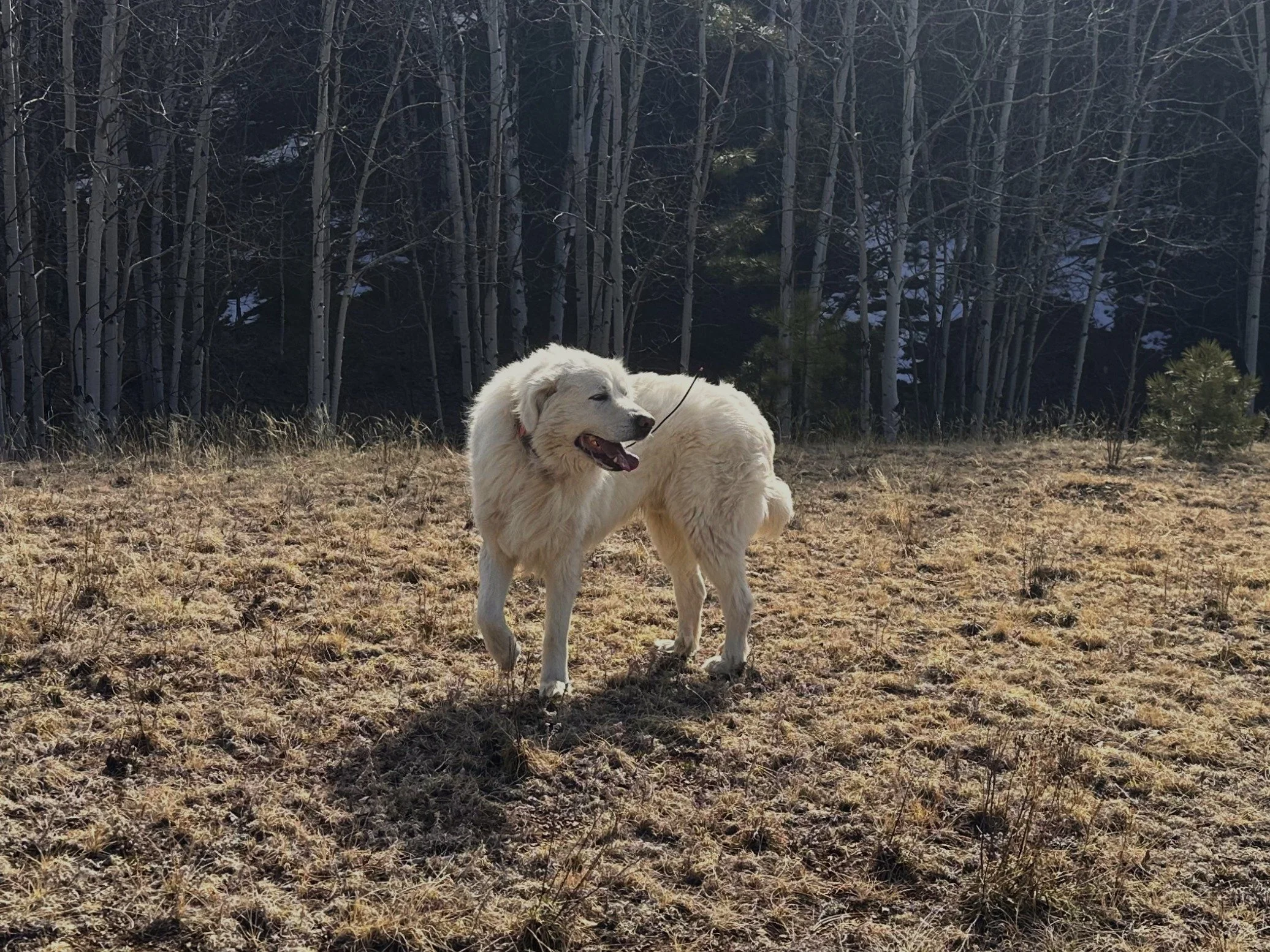
What is the Colorado Mountain Dog?
The Colorado Mountain Dog is a livestock guardian dog breed in development, created to meet the needs of modern homesteads and rural properties. The Colorado Mountain Dog was established by Wendy Francisco of Crack O’ Noon Farms in 2008 and today a growing community of dedicated breeders continue to work together to refine and develop genetically diverse lines to meet the breed standard.
Through careful selection of established livestock guardian breeds, breeders are working to produce dogs that retain strong protective instincts while also demonstrating stable, people-friendly temperaments suited to life close to families.
The goal of the breed is a balanced guardian—a dog with the instinct and confidence to deter predators, but also the temperament to live peacefully as part of a working farm household. As the breed continues to develop, breeders are focusing on consistency in temperament, reliability with livestock, and adaptability to the diverse environments of small farms, rural homes, and homesteads.
Why a New Livestock Guardian Breed?
Many established livestock guardian breeds have protected flocks for centuries, traditionally working in large pastoral systems where dogs lived primarily with livestock and had limited interaction with households or visitors. Modern homesteads are often much smaller and concentrated around the home, requiring a guardian that can protect livestock while also living safely and calmly around families, pets, and guests.
Individual dogs from traditional guardian breeds can certainly meet this need with proper training. However, many homesteaders also encounter common challenges such as wandering, escaping fences, excessive barking, or strong suspicion toward strangers, traits that can be difficult to manage on smaller rural properties.
LGD owners occasionally encounter exceptional dogs that seem to work almost “out of the box”—intuitive guardians that naturally balance strong livestock protection with steady, people-friendly temperaments. The Colorado Mountain Dog is being developed to refine and reproduce this type of dog, aiming for a livestock guardian well suited to the realities of modern homesteads, small farms, and rural family properties.
What are the breed crosses?
The Colorado Mountain Dog is not a specific breed cross or designer hybrid. Instead, it is a function-driven livestock guardian dog being developed by selecting individual dogs from established livestock guardian breeds based primarily on temperament, working ability, and sound structure, rather than fixed breed percentages.
While many early CMDs came largely from Great Pyrenees and Anatolian Shepherd lines, the breed may also incorporate other livestock guardian breeds such as Boz Shepherd, Maremma, Kuvasz, Akbash, and Tibetan Mastiff. Every dog must be individually evaluated, health tested, DNA tested, and approved through the Caspian Mountain Dog Registry (CMDR) before being used in breeding.
The goal of the program is not to create a “Pyr hybrid” or designer mix, but to develop a consistent livestock guardian that breeds true to the CMD standard and excels on modern homesteads and small farms.
Breed Standard
Physical Standard
Large, tall livestock guardian dog with a square body and medium build; leaner and more athletic than many traditional LGD breeds.
Long, well-boned legs with large, powerful feet suited for rough terrain and endurance.
Height & Weight
Males: ~29–33+ inches, 120–150+ lbs
Females: ~27–31+ inches, 80–120+ lbs
Head proportional to body with a rounded crown and a long, graceful muzzle with a slight concave slope.
Eyes large, wide-set, and expressive with a soft, open expression.
Ears medium-small, V-shaped with rounded tips; hang down but may rise semi-erect when alert.
Coat soft and silky rather than wooly or wiry; designed to stay relatively clean and easy to maintain.
Long coat: medium-length body hair with feathering on neck, legs, and tail.
Short coat: shorter double coat still suitable for winter protection.
Color primarily white, though markings and other colors are permitted (badger, brindle, agouti, silver, mink, black, tan, etc.).
Tail well-furred and loosely curled, carried relaxed at rest and arched gently when active.
Movement long-reaching, fluid, and powerful with an open, effortless gait.
Temperament & Working Traits
The Colorado Mountain Dog is bred to accept and greet people, unless a genuine threat is perceived.
Well-bred CMDs should approach people calmly and confidently, often greeting visitors with relaxed body language.
Dogs are highly perceptive of human intent and body language, which helps them distinguish normal visitors from real threats.
This people-friendly guardian temperament is the defining goal of the breed.
While similar individuals exist in other LGD breeds, the CMD is being developed by selecting this trait consistently across generations.
Traditional LGD breeds sometimes show default suspicion or hostility toward strangers, which can be problematic on smaller farms or public-facing operations.
A guardian dog that reacts aggressively toward visitors can create liability risks and unsafe situations, especially for farms that host customers, neighbors, or families.
Stable temperament is essential in breeding, and dogs used as parents should be confident and accepting of people.
Early socialization and regular human interaction are important to help puppies develop their natural temperament.
Because the breed is still developing, careful placement and evaluation of puppy temperament are important for responsible breeding programs.
The CMD is specifically being developed for small farms, homesteads, and properties where livestock, families, and visitors share the same space.
Well-bred CMDs can still work effectively on larger acreages, but their primary niche is a livestock guardian that works comfortably around people.